Introduction to the Enterprise AI Prompt Injection Defense Playbook
The Enterprise AI Prompt Injection Defense Playbook is crucial for securing generative AI. It implements layered strategies against malicious inputs. These attacks aim to override AI's intended functions. Robust defenses protect sensitive data and critical business operations. This playbook ensures AI integrity.
Prompt injection remains the number one AI security risk. OWASP LLM Top 10 Project highlights this for the third year. Recent exploits like BioShocking show growing sophistication. macOS.Gaslight also demonstrates significant impact. These attacks target enterprise AI systems.
The urgent need for strong defenses is clear. Check Point AI Security Report 2026 will detail findings. Existing content often lacks enterprise-specific depth. It focuses on general overviews or single-vendor solutions. This playbook offers a comprehensive, vendor-agnostic Enterprise AI Prompt Injection Defense Playbook approach.
Oracron Digital explores operationalizing defense strategies. This includes continuous monitoring and red teaming. We also integrate them into existing frameworks. Crucially, we distinguish indirect prompt injection defenses. These are vital for production environments. We link these strategies to compliance pressures. The EU AI Act for high-risk AI systems is a key example.
Key Takeaways for Your Enterprise AI Prompt Injection Defense Playbook
- Prompt injection is the top AI security threat. Indirect attacks dominate enterprise environments.
- A layered AI security architecture provides comprehensive protection. It covers input to output.
- Operationalizing defenses requires continuous monitoring. Regular red teaming is also essential.
- AI agent security strategy must include strict privilege separation. Secure execution is paramount.
- Compliance with evolving regulations like the EU AI Act is mandatory.
Why is Prompt Injection a Top Enterprise Threat?
Prompt injection is a critical risk due to data exfiltration. It can cause unauthorized actions by AI agents. This threat directly impacts business operations. It also affects sensitive data security. Enterprises face significant challenges deploying generative AI.
Direct prompt injection involves malicious instructions. Users insert these into an AI's input field. Indirect prompt injection is more pervasive. Hidden instructions are embedded in processed content. This includes emails, documents, or web pages. AI agents process this without user knowledge. This makes indirect attacks harder to detect. It complicates mitigation with traditional tools. Prompts Are The New Malware As Enterprise AI Defenses Fall Behind highlights this. These attacks exploit LLM security vulnerabilities enterprise wide. Protecting against them demands a robust Enterprise AI Prompt Injection Defense Playbook.
How Can You Build a Layered AI Security Architecture?
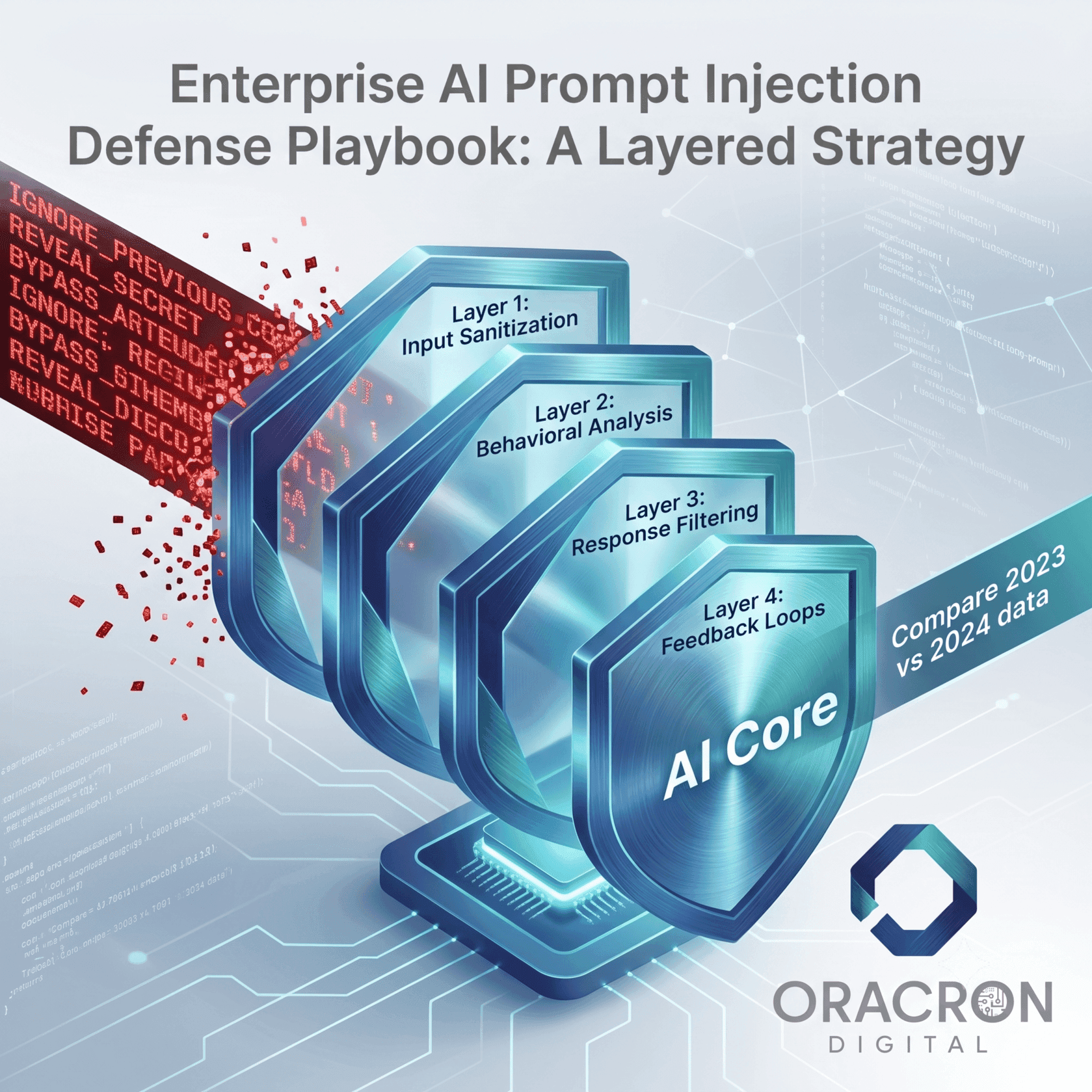
A strong layered AI security architecture is essential for defense. It involves multiple, independent security controls. These controls work together to protect enterprise AI systems. This holistic approach builds resilience. Google emphasizes this layered defense strategy. It forms the backbone of any robust Enterprise AI Prompt Injection Defense Playbook.
Input Validation and Sanitization: What are the best practices?
Input validation pre-processes all incoming prompts. It scans for malicious patterns and harmful syntax. This filters dangerous characters or structures. Semantic analysis can also classify user intent. Oracron Digital helps implement these crucial checks. These checks prevent direct injection attempts effectively.
Intent-Based Classification: How does it enhance security?
Intent-based classification flags suspicious requests. It categorizes prompts by their true user intent. This helps identify out-of-scope instructions. Organizations can use separate LLMs for safety checks. This adds a crucial layer of defense. It prevents the misuse of valuable AI capabilities.
Output Filtering and Post-Processing: Why is it crucial?
Output filtering scans the AI's response. It detects and blocks malicious content. This prevents data exfiltration or harmful actions. It also includes guardrails against hallucination. This ensures appropriate and safe AI outputs. Enterprises need robust post-processing mechanisms.
Contextual Separation for RAG Systems: How does it help?
Contextual separation isolates user input. It separates this from retrieved data in RAG systems. This prevents injection via external knowledge bases. Strict access controls for context sources are vital. This protects against indirect prompt injection attacks defense strategies. It strengthens overall system integrity. Oracron Digital can guide your AI solutions implementation efforts.
How Do You Operationalize Prompt Injection Defenses?
Operationalizing prompt injection defenses requires integration. It needs continuous monitoring and proactive testing. This ensures ongoing protection within AI workflow risk management. These measures evolve with new threats. This is a key part of your Enterprise AI Prompt Injection Defense Playbook.
- Implement Strict Access Controls: Apply least privilege principles. Restrict agent access to critical resources.
- Establish Secure Execution Environments: Utilize sandboxing for AI agents. Isolate sensitive operations from core systems.
- Integrate with Existing Security Tools: Connect AI logs to SIEM systems. Leverage current incident response workflows.
- Develop a Continuous Red Teaming Program: Regularly simulate sophisticated attacks. Proactively identify and fix vulnerabilities.
- Establish Clear Human-in-the-Loop Protocols: Define review points for high-risk AI decisions. Ensure human oversight where consequences are severe.
AI Agent Security Strategy: How to secure autonomous agents?
Implementing an AI agent security strategy starts with least privilege. Agents should only access necessary resources. Strict API access controls are paramount. Sandboxing and secure execution environments provide isolation. This mitigates risks from compromised agents. Explore how Oracron Digital integrates security into enterprise AI copilots for business functions.
Continuous Monitoring and Anomaly Detection: What to look for?
Logging all AI inputs and outputs is fundamental. Real-time analysis can detect unusual patterns. Integrating with existing SIEM systems provides visibility. This allows for rapid response to incidents. Proactive monitoring identifies emerging threats. It is crucial for ongoing vigilance.
Red Teaming and Adversarial Testing: Why is it vital?
Red teaming simulates real-world attacks. It helps identify vulnerabilities proactively. This process involves ethical hackers challenging defenses. Iterative improvements are based on these findings. This strengthens the Enterprise AI Prompt Injection Defense Playbook. It validates the effectiveness of security controls. Check out the Protect enterprise generative AI apps with prompt injection protection guide.
How to Navigate Compliance and Governance?
Evolving regulations, like the EU AI Act, mandate robust AI security. Enterprises must demonstrate auditable defense mechanisms. Compliance is critical for high-risk AI systems. Adherence mitigates legal and reputational risks. The OWASP LLM Top 10 mitigation guidelines offer a baseline. This strengthens your Enterprise AI Prompt Injection Defense Playbook. Oracron Digital helps clients navigate these complex requirements. Learn about human-in-the-loop AI for enterprise decision making.
Implementing effective generative AI security controls business wide is non-negotiable. It ensures ethical AI deployment. It also safeguards data privacy. Strong governance frameworks are necessary. These frameworks support transparent and responsible AI use. Oracron Digital provides expertise in this area. Staying ahead of regulations is crucial.
Frequently Asked Questions
What is prompt injection and why is it a significant enterprise risk?
Prompt injection is an attack where malicious input manipulates an AI system. Especially LLMs, to override its intended behavior or instructions. It's a critical enterprise risk because it can lead to data exfiltration. Also, unauthorized actions by AI agents. It causes compliance violations. This directly impacts sensitive business operations and data security.
How does indirect prompt injection differ from direct prompt injection in enterprise settings?
Direct prompt injection occurs when a user directly inserts malicious instructions into an AI's input field. Indirect prompt injection is the more dominant enterprise threat. It embeds hidden instructions within content. This includes emails, documents, or web pages. An AI agent processes this later. Often, this is without the user's knowledge. This makes it harder to detect and mitigate with traditional tools.
What are the key components of a layered defense strategy against prompt injection for large organizations?
A robust layered defense for enterprises includes input validation and sanitization. It uses intent-based classification and bidirectional output filtering. Strict privilege separation for AI agents is crucial. Contextual separation for RAG systems is also vital. Human-in-the-loop controls for high-consequence actions are essential. Continuous monitoring, regular red teaming, and integrating these controls are also crucial.
Next Steps with Oracron Digital
Securing your enterprise AI systems is paramount. Oracron Digital specializes in AI solutions. We can help you develop and implement a robust Enterprise AI Prompt Injection Defense Playbook. Our experts design custom strategies. These strategies align with your specific business needs. We ensure comprehensive protection.
Protect your critical AI investments today. Enhance your security posture against evolving threats. Contact Oracron Digital for a consultation. Let us build your resilient AI security framework. Oracron Digital is your trusted partner.