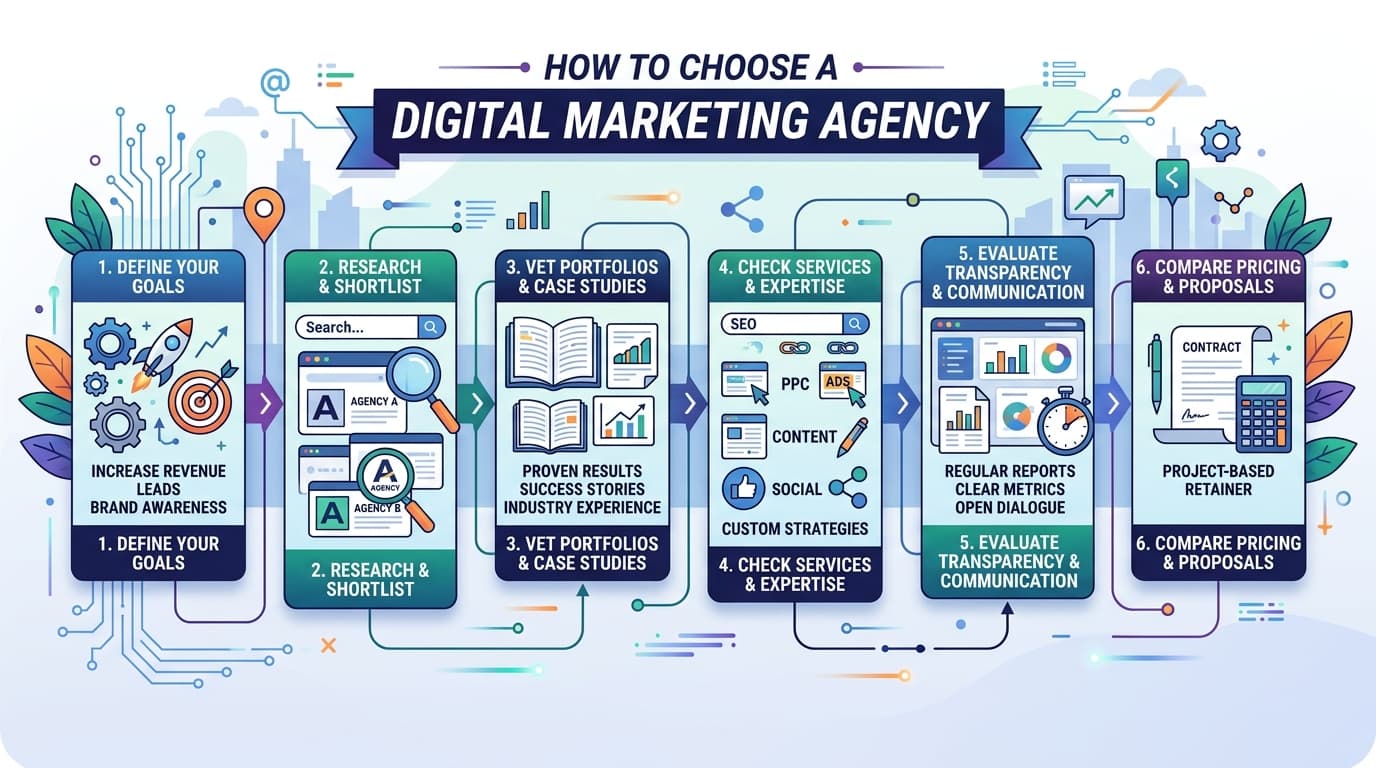
Most agencies promise results. Very few deliver them.
Choosing a digital marketing agency is one of the most consequential decisions a growing business makes in 2026. Pick the right partner and your revenue compounds. Pick the wrong one and you're locked into a contract, watching your budget disappear while the reports get prettier and the results stay flat. This guide walks you through exactly how to find and hire a digital marketing agency that earns its retainer, covering everything from defining your goals and evaluating agency expertise to spotting red flags, understanding pricing models, and asking the questions that separate genuine partners from polished sales pitches. Whether you're searching for a digital marketing agency for your business, comparing full-service shops to specialists, or simply trying to figure out how to vet a marketing agency before signing anything, these steps apply directly to your situation.
Step 1: Get specific about what you actually need
Before you speak to a single agency, define success in concrete business terms. "More marketing" or "better digital presence" are not useful briefs. They produce broad proposals that are hard to evaluate and impossible to hold accountable.
Ask yourself:
- Do you need more leads, or better-quality leads?
- Is your problem visibility (nobody finds you) or conversion (people find you but don't buy)?
- Which channels matter most: organic search, paid ads, social, email, or all of them?
- What does success look like in 90 days? In 12 months?
The clearer your brief, the easier it is to filter out agencies that don't fit. Most businesses hire agencies with vague goals and then get vague outcomes. That's not entirely the agency's fault. It starts before the first call.
Also, be honest about your budget ceiling early. Most small to mid-size businesses invest anywhere from $2,000 to $10,000 per month depending on the services involved. Paid advertising adds ad spend on top of the management fee. Know your numbers before you sit across from a sales team.
Step 2: Understand the difference between full-service and specialist agencies
This is a fork in the road that most guides gloss over. The right answer depends entirely on your situation.
A full-service digital marketing agency offers everything from SEO to social media. A niche agency focuses on one area, like PPC or content marketing. Full-service is convenient, but a specialist often provides deeper expertise. Your choice depends on whether you need a broad solution or an expert for a specific channel.
A practical rule of thumb: choose a specialist if you're focused on one channel. They go deeper, faster. Go full-service if you need multi-channel execution or have limited in-house resources. Many brands start with specialists and expand later.
One thing to watch out for: "full-service" sounds appealing, but it can also mean "we do everything at a surface level." A small team of five people cannot genuinely be experts across SEO, paid media, email, and web design at the same time. Ask who specifically handles each channel, and what their track record looks like in that discipline alone.
Step 3: Dig into proof, not promises
Every agency on the planet claims to be results-driven, data-led, and full-service. The language is consistent across the market regardless of actual capability. So stop listening to what they say and start examining what they can show.
Here's what real proof looks like:
- Case studies with commercial outcomes. Traffic growth for a completely different business type tells you almost nothing. Ask for results expressed as leads generated, revenue attributed, or customer acquisition cost reduced. Case studies from businesses facing similar challenges, with results expressed in commercial outcomes rather than vanity metrics, tell you considerably more.
- How they handle failure. Ask an agency about a campaign that didn't perform as expected and how they handled it. This question reveals more than any case study. Agencies that have done real work have things that didn't work as planned. How they respond to underperformance — whether they identified it quickly, communicated it honestly, and adjusted the approach — is what determines whether they're a genuine partner or a vendor managing their relationship.
- Client references. Ask for two or three. Then actually call them.
Be wary of agencies that only show vanity metrics, such as impressions or follower counts, without tying them to actual business outcomes. Impressions don't pay salaries. Revenue does.
Step 4: Ask the questions most businesses forget
The sales call is polished. The deck is beautiful. But the person selling to you is rarely the person who will work on your account. That matters enormously.
You often talk to a polished sales rep or the agency owner during the pitch. But who will actually do the work? If they refuse to let you speak to the account manager or specialist who will handle your campaigns, run. This usually means your account will be handed off to a junior employee or outsourced to a white-label provider the moment you sign.
Beyond that, the questions that cut through the noise in 2026:
- What does your onboarding process look like? The first 60 to 90 days with an agency set the tone for everything that follows. A solid onboarding process means they're investing time upfront to understand your business, competitors, target audience, and goals, not just logging into your ad accounts and running.
- How do you track and report performance? Clients now expect a live dashboard, not a PDF. If your retainer ends with a slide deck instead of a Looker Studio link, you are already losing.
- How are you adapting to AI search? GEO (Generative Engine Optimisation) is the new baseline requirement. Agencies that cannot explain how a client shows up inside ChatGPT, Perplexity, or Google AI Overviews are getting fired.
- What happens when a campaign underperforms? What's their process when a campaign underperforms? Do they proactively flag issues, or do you have to chase them for answers?
- Who owns the data assets? If an agency refuses to give you administrative ownership of your Google Analytics 4 property, Meta Business Manager, or CRM integrations, they are effectively holding your business intelligence hostage.
Step 5: Understand pricing and contracts before you sign
Pricing transparency is a quality signal in itself. Pricing models vary: monthly retainers, project-based fees, performance-based models, or some hybrid. None is universally better, but you need to know exactly what you're paying for. Ask what's included at your price point, what triggers additional costs, and how they handle scope changes.
On contracts: agencies want security, but you should not be trapped in a 12-month contract with a partner who doesn't deliver. A standard agreement should have a 30-day or 60-day out clause. If they demand a one-year lock-in with no escape hatch, they are likely more focused on cash flow than results.
One more thing worth knowing: no one can guarantee a number-one ranking on Google. The search algorithms change daily. If an agency promises this, they are lying or using black-hat tactics that will get your site penalised. Any agency that opens with a guarantee is one you should cross off the list immediately.
What the numbers say about digital marketing in 2026
The scale of the market makes choosing wisely more important than ever. The global digital advertising and marketing market is projected to reach $786.2 billion by 2026, growing at a compound annual growth rate of 13.9%. With that kind of money moving through the ecosystem, the gap between agencies that deliver and those that don't has never been wider.
A few figures worth keeping in mind as you evaluate candidates:
- The average digital marketing agency retainer ranges from $3,000 to $10,000 per month, with SEO delivering an average 702% ROI over three years.
- Zero-click searches now make up 65% of all Google searches in 2026, making featured snippets and AI-generated answer placements more important than raw ranking positions.
- Content marketing generates 3x more leads per dollar than paid search , which is why the best agencies treat content as infrastructure, not a deliverable.
- Agencies that have not invested in first-party tracking are showing clients reports that are quietly wrong by 30 to 50%. That's not a rounding error. That's a strategy built on bad data.
The takeaway: the right agency partnership compounds over time. The wrong one compounds your losses.
Why this matters more than most business decisions
Hiring a digital marketing agency is not like buying software. You can cancel a SaaS tool in a click. A bad agency relationship costs you months of budget, lost market timing, and sometimes real damage to your search rankings or brand reputation.
The good news is that the average client-agency relationship now lasts around 7 years, up from 3.2 years in 2016. High-quality agencies keep their clients because they deliver value. That means the agencies worth working with tend to stay in business, stay accountable, and keep getting better. Your job is simply to find one of them, not just the one with the best pitch deck.
Take the process seriously. Run the questions above. Check the contract terms. Speak to real clients. And remember: if an agency cannot market itself effectively, it cannot market you. Check their blog, their rankings, their social presence. What they do for themselves is a live preview of what they'll do for you.
FAQ
How long does it take to see results from a digital marketing agency?
Expect early signals such as clicks and leads within 45 to 90 days. Paid ads show traction faster; SEO or content can take 4 to 6 months. Sustainable ROI often takes up to 12 months. Set milestone goals, for example lowering your cost per lead by month three, and avoid agencies promising instant wins.
What is the difference between a full-service and a specialist digital marketing agency?
A full-service agency handles multiple channels under one roof: SEO, paid media, social, web design, and more. A specialist agency focuses on one or two areas. Full-service agencies offer convenience and integrated strategy; specialists often go deeper in their niche. The right choice depends on how complex your needs are and how hands-on you want to be managing multiple vendors.
What red flags should I watch for when evaluating an agency?
The biggest ones: guaranteed number-one rankings (a sign of black-hat tactics or outright dishonesty), refusal to let you speak to the team who will do the actual work, no clear out clause in the contract, reports built entirely on vanity metrics like impressions and follower counts, and refusing to give you administrative ownership of your GA4 property, Meta Business Manager, or CRM integrations. If data ownership isn't yours, your business intelligence isn't yours.
How much should I budget for a digital marketing agency in 2026?
Most small to mid-size businesses invest anywhere from $2,000 to $10,000 per month depending on the services involved. Paid advertising has additional ad spend on top of the management fee. It's worth understanding what each channel costs before you begin conversations with agencies so you can separate realistic proposals from lowball bids that are just trying to get you in the door.
Should I ask an agency how they use AI in their work?
Absolutely, and listen carefully to the answer. It is fine if an agency uses AI to draft content or generate creative variants, but someone should still be responsible for accuracy, voice, and quality review. If they cannot explain that review step, you are not hiring a team — you are renting a content generator. In 2026, AI use is expected; undisclosed, unreviewed AI output is a warning sign.