Beyond the Hype: Building Production-Ready Retrieval Augmented Generation for Enterprise AI in 2026
Retrieval Augmented Generation (RAG) for Enterprise AI is a foundational framework. It grounds Large Language Models (LLMs) with trusted, domain-specific knowledge. This approach mitigates LLM hallucinations. It enables access to proprietary data for real-world business applications.
Key Takeaways for Enterprise RAG
- RAG is a cornerstone for enterprise AI architecture by 2026.
- It dramatically reduces LLM hallucinations with factual grounding.
- Robust RAG requires careful architectural design and data governance.
- Advanced RAG techniques are vital for overcoming common failure modes.
- RAG acts as a critical context layer for autonomous AI agents.
What is Retrieval Augmented Generation (RAG) for enterprise AI?
Retrieval Augmented Generation (RAG) is an AI framework. It enables large language models (LLMs) to access and synthesize information. This comes from external, proprietary knowledge bases in real-time. This augments the LLM's pre-trained knowledge. It generates accurate, contextually relevant responses.
This ensures factual grounding for specific enterprise data and use cases. RAG is quickly becoming a strategic imperative in 2026. RAG in 2026: Bridging Knowledge and Generative AI highlights its importance. Nearly 90% of companies will rely on it. This grounds LLMs with trusted, domain-specific knowledge. It ensures LLMs leverage up-to-date information.
How does RAG help reduce LLM hallucinations in business applications?
RAG significantly reduces LLM hallucinations. It grounds the model's responses in verifiable information. This data is retrieved from trusted internal data sources. The LLM receives specific, relevant context. It prevents fabricating or generating incorrect information. This greatly improves factual accuracy in business applications.
Instead of relying on static training data, RAG provides dynamic context. An academic thesis confirms RAG's effectiveness. Reducing Hallucinations in Enterprise Generative AI with Retrieval-Augmented Generation discusses this in detail. It grounds LLMs for internal documentation. This enhances reliability. How RAG Architecture Overcomes LLM Limitations further explores these benefits. This is crucial for enterprise knowledge retrieval.
What are the key architectural components required for an enterprise RAG system?
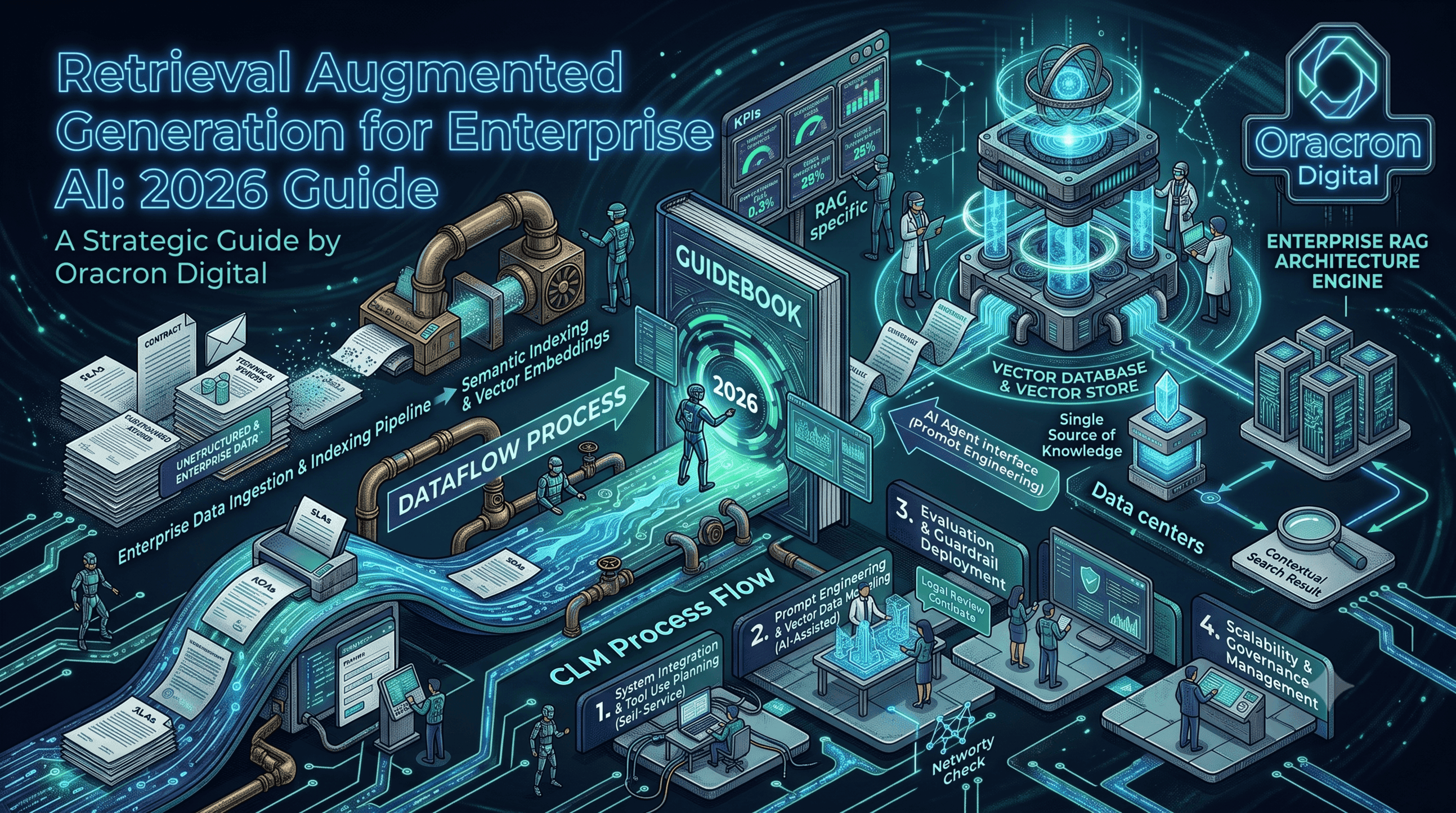
A robust enterprise RAG system requires several key components. An ingestion pipeline processes and chunks enterprise data. This prepares text for embedding. An embedding model then converts text into vector representations. These numerical vectors capture semantic meaning.
A vector database stores these embeddings for efficient similarity search. The global vector database market reached $3.2 billion in 2025. It is growing annually by 24%. This highlights its critical role. Next, a retrieval mechanism finds relevant data. An orchestration layer (e.g., LlamaIndex) manages the flow. This connects components to the generative LLM. LlamaIndex RAG for Enterprise LLMs provides insight into its enterprise capabilities. This comprehensive RAG architecture enterprise setup ensures data grounding for LLMs.
Building Production RAG Pipelines: Addressing Enterprise Challenges
Deploying Retrieval Augmented Generation for Enterprise AI presents unique challenges. Oracron Digital designs production RAG pipelines. We ensure seamless integration with existing systems. This avoids common pitfalls. Our solutions prioritize scalability and reliability.
How can enterprises integrate RAG with complex existing data infrastructure?
Integrating RAG into existing data infrastructure demands careful planning. Enterprises often face data silos. These include disparate databases, data lakes, and document management systems. Building efficient, robust ingestion pipelines is crucial. These pipelines extract, transform, and load diverse data. They prepare it for vectorization and indexing.
Oracron Digital focuses on modular architectures. This facilitates custom data source connectors. It ensures compatibility with various enterprise systems. Our approach minimizes disruption. It maximizes the value from proprietary data. Maintaining high AI-Driven Enterprise Data Quality for Generative AI is paramount for effective RAG. This enables strong enterprise knowledge retrieval.
What common RAG failure modes should enterprises avoid?
Enterprises must proactively address common RAG failure modes. One such issue is semantic fragmentation. This occurs when content chunks are too small. They lose vital context for comprehensive understanding. Weak reranking might prioritize irrelevant results. This happens despite initial retrieval of relevant chunks.
Context overload is another challenge. Too much retrieved information dilutes relevance. It can confuse the LLM. The "no answer" problem arises when information is genuinely missing. Oracron Digital designs strategies for these issues. We optimize chunking strategies and implement robust reranking models. We also monitor context window usage. These steps are critical for production RAG pipelines.
How do advanced RAG techniques improve reliability and accuracy?
Advanced RAG techniques significantly enhance enterprise RAG solutions. GraphRAG leverages knowledge graphs. This connects disparate pieces of information. It improves contextual understanding and reasoning capabilities. Self-RAG allows the LLM to reflect on its retrieval. It can then refine its query or re-retrieve. This iterative process boosts accuracy significantly.
Other advanced approaches include hybrid search and query expansion. Hybrid search combines vector and keyword search. Query expansion enriches user queries. These techniques move beyond basic keyword matching. They enable more nuanced information retrieval. They strengthen data grounding for LLMs. This ensures higher quality outputs. Oracron Digital implements these advanced RAG techniques. This delivers superior performance in complex scenarios. Explore AI Agent Orchestration for Complex Enterprise Workflows for further context.
Ensuring Data Governance and Compliance in Enterprise RAG
Data governance and compliance are paramount for enterprise AI. RAG systems handle sensitive proprietary information. Robust controls are absolutely necessary. This protects data integrity and privacy. It also ensures regulatory adherence.
How can enterprises implement robust data governance and access controls for RAG?
Implementing data governance for RAG starts with clear policies. Define who can access what data within the system. Granular access controls must be enforced. This applies at the document and chunk level. Role-based access ensures data security. It prevents unauthorized information exposure. This is crucial for Retrieval Augmented Generation for Enterprise AI.
PII filtering and anonymization techniques are essential. They protect sensitive personal information. Data lineage tracking maintains audit trails. This ensures compliance with regulations like GDPR or HIPAA. Regular audits verify control effectiveness. Gartner Hype Cycles for 2026: RAG Moves From Experimentation to Enterprise Infrastructure confirms this shift. For comprehensive guidance on responsible AI, explore Operationalizing Responsible AI for Enterprise: A 2026 Guide. This supports ethical AI deployment.
- **Define Clear Data Access Policies:** Establish explicit rules for data usage and sharing.
- **Implement Granular Access Controls:** Secure information at the document, paragraph, or sentence level.
- **Apply PII Filtering & Anonymization:** Use techniques to mask or remove personally identifiable information.
- **Maintain Data Lineage and Audit Trails:** Track every data modification and access for compliance.
- **Conduct Regular Security Audits:** Systematically review security controls and compliance postures.
RAG as the Context Layer for Enterprise AI Agents
Retrieval Augmented Generation extends beyond simple question-answering. It serves as a vital context layer. This empowers autonomous AI agents. It also supports complex, multi-step business workflows. This marks a significant evolution in enterprise AI.
How does RAG enable autonomous AI agents for complex workflows?
RAG provides real-time, accurate information to AI agents. These agents can then execute tasks requiring up-to-date knowledge. For example, a customer service agent can retrieve relevant product manuals. It can access past interaction histories. An IT operations agent might query incident reports. It accesses diagnostic procedures. This context layer enhances agent decision-making. It ensures actions are based on precise enterprise data. This is crucial for production RAG pipelines.
Oracron Digital leverages RAG for advanced agent capabilities. This supports scenario-based reasoning. It enables dynamic plan generation. The agent can adapt based on retrieved context. This moves beyond predefined rules. RAG helps agents handle unexpected situations. For more insights on agents, refer to LLMOPs for Enterprise AI Agents Beyond Pilots in 2026. This showcases enterprise AI inference optimization strategies.
Frequently Asked Questions About Retrieval Augmented Generation for Enterprise AI
What is Retrieval Augmented Generation (RAG) for enterprise AI?
Retrieval Augmented Generation (RAG) is an AI framework that enables large language models (LLMs) to access and synthesize information from external, proprietary knowledge bases in real-time. This augments the LLM's pre-trained knowledge, allowing it to generate more accurate, contextually relevant, and factually grounded responses, especially for specific enterprise data and use cases.
How does RAG help reduce LLM hallucinations in business applications?
RAG significantly reduces LLM hallucinations by grounding the model's responses in verifiable, up-to-date information retrieved from trusted internal data sources. Instead of relying solely on its static training data, the LLM receives specific, relevant context from the retrieval step, preventing it from fabricating or generating incorrect information and improving its factual accuracy.
What are the key architectural components required for an enterprise RAG system?
A robust enterprise RAG system typically requires several key components: an ingestion pipeline for processing and chunking enterprise data, an embedding model to convert text into vector representations, a vector database for efficient similarity search, a retrieval mechanism to find relevant data, and an orchestration layer (e.g., LangChain, LlamaIndex) to manage the flow between these components and the generative LLM.
Next Steps with Oracron Digital
Mastering Retrieval Augmented Generation for Enterprise AI is crucial. Oracron Digital specializes in building advanced RAG solutions. We help enterprises leverage their proprietary data. Our expertise ensures reliable, compliant, and performant AI systems. Transform your enterprise AI capabilities. Contact Oracron Digital today to discuss your RAG project. You can also explore our AI Solutions.