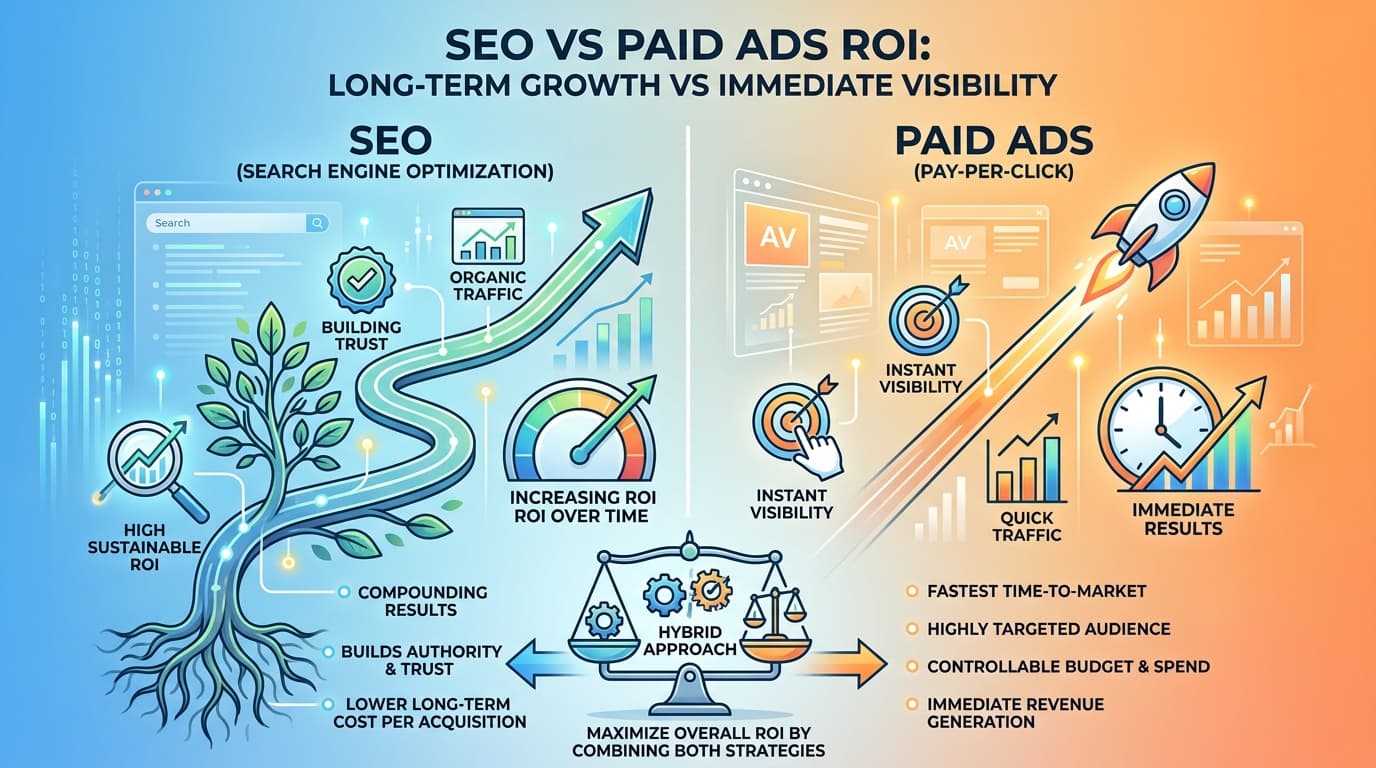
The question every business owner asks before signing a marketing contract
You have a budget. You need results. And two salespeople are sitting in your inbox — one pitching Google Ads, the other promising page-one rankings. Both sound convincing. Both quote impressive numbers. So which one actually delivers better return on investment?
The honest answer is: it depends on your timeline, your industry, and how you define "better." But the data tells a surprisingly clear story once you look past the pitch decks.
This post breaks down SEO vs paid ads ROI using real benchmarks from 2025 and 2026 — covering cost per lead, conversion rates, long-term compounding value, and the scenarios where each channel genuinely wins. By the end, you'll know exactly how to allocate your budget.
The raw numbers: what ROI actually looks like for each channel
Start with the headline figures, because they're striking.
The average SEO ROI is 22:1, meaning $22 back for every $1 spent. The average return on ad spend for paid search sits at around 2:1. That's a gap worth paying attention to.
Dollar-for-dollar comparisons make this even clearer. For a $100,000 annual digital marketing budget, SEO can generate $51,724 in revenue versus $23,275 from PPC. Same spend, more than double the output — if you're willing to wait for it.
Cost per lead tells a similar story. Organic search generates leads at an average cost of $14, providing a 68% cost advantage over PPC's $44 average cost per lead.
And conversion rates? SEO conversion rates average 2.4% across industries, nearly double the 1.3% average conversion rate of PPC traffic. The trust factor drives this gap. HubSpot data indicates that approximately 70% of searchers actively skip ads to click on organic results.
None of that means paid ads are a waste. It means they serve a different purpose — and the ROI clock runs differently for each.
The timeline problem: when each channel actually pays off
This is where most businesses make the wrong call. They compare SEO and PPC at the wrong point on the timeline.
Paid ads win at month one. Full stop. In the first month, the ROI narrative is overwhelmingly dominated by paid advertising. Campaigns launch and start generating traffic, clicks, and conversions within 24-48 hours. If you need leads this month, SEO cannot help you.
SEO, on the other hand, is an asset that compounds. It takes 6-12 months for positive SEO ROI to materialise — yes, it's a long game. But here's what changes after that initial runway:
- After 12 months, organic search becomes 5-10 times more cost-effective than paid search.
- The total cost of ownership for organic search over 24 months is 40% lower than paid search for the same traffic volume (Conductor, 2024).
- Over time, the cost per lead generated through organic traffic tends to decrease as rankings stabilise.
Paid ads have the opposite dynamic. PPC pricing trends reveal escalating costs across industries, with average CPCs climbing 15-20% annually. The cross-industry average CPC for Google Search campaigns in 2026 is $2.96, up 12% year-over-year. That number will be higher again next year.
The crossover point — where SEO's cumulative ROI surpasses paid — typically falls between months 6 and 12. The ROI of SEO and PPC does not scale linearly; they cross over at a critical point, typically between 6 and 12 months, which dictates the optimal blended strategy.
Where paid ads genuinely win (and SEO can't compete)
Paid advertising deserves a fair hearing. There are real scenarios where it's the smarter choice, and being honest about that makes the comparison actually useful.
Speed is non-negotiable. If you're launching a new product, running a seasonal promotion, or entering a market where you have zero organic presence, paid advertising excels during product launches, seasonal promotions, and time-sensitive campaigns where immediate visibility is crucial.
Targeting precision. Modern PPC platforms offer targeting capabilities that far exceed what's possible through organic search. Advertisers can precisely define their audience based on demographics, interests, behaviours, and intent signals. If your ideal customer is "CFOs in manufacturing companies with over 200 employees," paid ads can find them. SEO cannot.
Competitive keywords. Some industries face CPCs that look terrifying but still make sense. There are instances when paid ads can yield a better ROI, particularly when businesses target competitive keywords where ranking organically would take years of sustained effort.
Data gathering. PPC acts as a data engine — use the immediate, clean data from paid campaigns to validate high-converting keywords and ad copy. If a keyword converts well in a paid campaign, it should be the top priority for SEO content creation. This is one of the smartest ways to use PPC when your budget is limited.
What the numbers say about long-term organic value
A handful of figures that rarely appear in the standard pitch decks:
SEO-focused content strategies deliver 748% ROI for B2B companies, outperforming all other marketing investments. That figure comes from long-term B2B campaigns where content compounds over years, not months.
Organic search accounts for more than 53% of all website traffic, making it the most important channel for brand discovery and long-term momentum.
PPC costs are inflating rapidly — 87% of industries saw their cost-per-click rise in 2025, with high-stakes sectors like legal services reaching $131.63 per lead.
Nearly 49% of marketers cite SEO as their most profitable marketing channel.
And perhaps the most underappreciated stat: the number-one organic result earns approximately 39.8% CTR on searches without AI Overviews. Even factoring in the impact of AI Overviews, the top organic result still receives roughly 19 times more clicks than the top paid placement.
19 times. Not 19%. Nineteen times more clicks. That's the visibility gap you're building toward with SEO.
Why this comparison matters beyond the spreadsheet
There's a deeper question sitting underneath the ROI numbers. It's not just about cost per lead — it's about what kind of business asset you're building.
SEO is best viewed as owning digital real estate — a long-term, high-value asset. PPC is a rental model, offering immediate occupancy but requiring continuous payment. The moment you stop paying rent, the flat is empty again.
When you rely only on paid ads, you're renting your visibility, not building it. The moment you stop paying, the leads stop coming. No slow decline. No residual traffic. Just silence.
SEO compounds differently. SEO's most compelling advantage is its cumulative return on investment that increases over time. Unlike PPC, where each click represents a new cost, SEO investments continue delivering traffic long after the initial work is completed. This creates a snowball effect where ranking improvements for one keyword often positively impact related terms, expanding visibility across the industry's search results.
There's also a competitive moat argument worth making. Once a business earns top organic rankings, competitors cannot simply outbid them to take those positions. They must invest the same time and resources to build the same authority. That is a durable competitive moat. PPC offers no such protection — any competitor with a larger budget can immediately outbid you and take your traffic.
Think about what that means at renewal time when a well-funded competitor enters your space.
The smartest approach: using both channels strategically
The most profitable businesses don't choose sides. They use each channel for what it actually does well, and they let data flow between them.
An integrated approach has been shown to produce a 35% increase in marketing-qualified leads and a 22% reduction in overall marketing costs. Those aren't rounding errors — they're the compounding effect of two channels reinforcing each other.
Strong organic authority also reduces your paid CPC and improves your paid ad CTR, because Google's quality scoring rewards overall relevance. SEO makes your ads cheaper. Paid ads validate your SEO targets faster. The relationship runs both ways.
A practical budget framework based on your situation:
- New business, need results now: Start with PPC to generate immediate cash flow, use conversion data to identify your best-performing keywords, then build SEO content around those terms.
- Established business with a 6-12 month runway: Spend 60% on SEO and 40% on ads. You invest heavier in the higher-ROI channel while maintaining some immediate traffic.
- Scaling business (year 2+): Shift to 70% SEO and 30% ads in year two, then 85% SEO with 15% reserved for strategic campaigns only by year three.
HubSpot's 2026 State of Marketing shows websites, blogs, and SEO among the top channels for ROI, while PPC remains effective for time-sensitive pushes and testing. That framing captures the right mental model: SEO as the engine, paid as the accelerator you use when and where it earns its keep.
FAQ
Does SEO always deliver better ROI than paid ads?
Not always — it depends on your timeline. Paid advertising is the clear winner for immediate revenue generation and cash flow in the short term. However, at the 12-month mark, SEO becomes the clear long-term champion, delivering a vastly superior, compounding ROI that reduces reliance on continuous ad spending. If you need revenue this month, start with paid. If you're building for next year, prioritise SEO.
How long does SEO take to show ROI?
Paid ads bring immediate results, while SEO typically takes 3-6 months to start working. For most websites, meaningful organic traffic gains appear around the 4-6 month mark, with full ROI compounding over 12-24 months. Local SEO can show results faster. For location-based businesses, local SEO and Google Business Profile optimisation can produce visible results in weeks rather than months.
What is a realistic cost per lead for SEO vs PPC?
Search engine optimisation generates leads at an average cost of $14, providing a 68% cost advantage over PPC's $44 average cost per lead. These are cross-industry averages, and they vary significantly by sector. High-competition industries like legal services face far higher PPC costs per lead, which often makes organic an even more attractive long-term investment.
Can running SEO and PPC together improve results?
Yes, and the data supports it. Combining both strategies increases total conversions by 67%. Research from WordStream indicates that when a brand appears in both paid and organic results for the same query, the combined CTR can increase by up to 40%. The two channels actively lift each other's performance when they share strategy, keywords, and messaging.
Is PPC worth it if my industry has high CPCs?
It requires careful analysis. 87% of industries saw their CPC rise in 2025, with high-stakes sectors like legal services reaching $131.63 per lead. In high-CPC industries, the ROI case for PPC weakens significantly unless your average deal value is large enough to absorb the cost. In those cases, organic search typically converts at a higher rate and high CPCs make organic the more cost-effective long-term option. Use PPC for bottom-funnel, high-intent terms where conversion is near-certain, and build SEO for everything else.