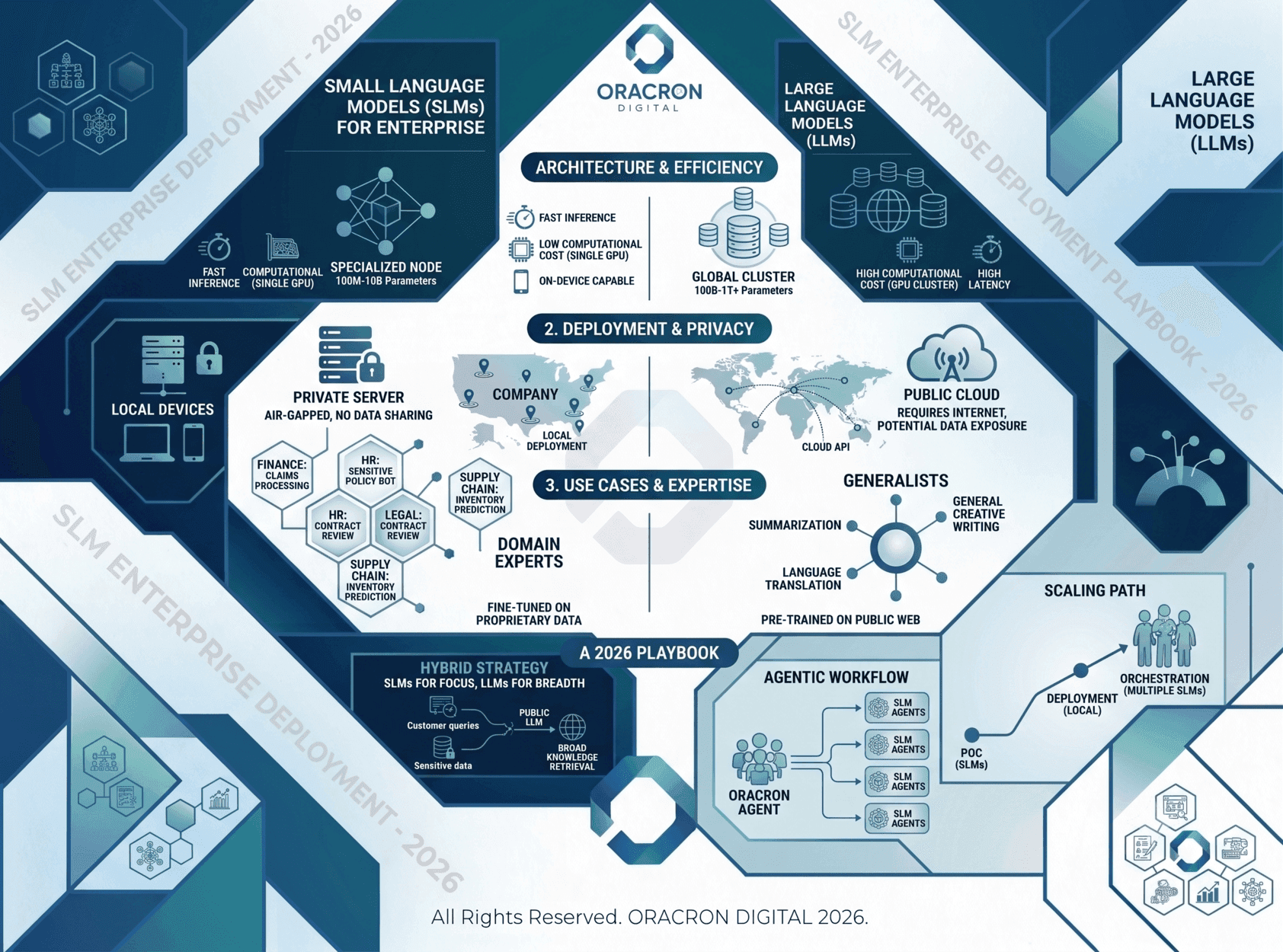
Small Language Models for Enterprise: A 2026 Adoption Playbook
Small Language Models for Enterprise are poised to redefine AI adoption in 2026. They offer businesses superior cost-effectiveness, enhanced privacy, and domain-specific precision. This playbook guides enterprise leaders in leveraging SLMs for significant ROI. It ensures data sovereignty in a rapidly evolving AI landscape.
Key Takeaways for Enterprise AI Leaders
- SLMs offer immense value over general LLMs for specific tasks.
- Fine-tuning SLMs with proprietary data is crucial for domain accuracy.
- A hybrid AI strategy combines SLMs for efficiency and LLMs for complexity.
- Operational challenges require robust deployment and governance frameworks.
- SLMs drive significant Enterprise AI ROI and enhance data privacy.
Why are Small Language Models for Enterprise Gaining Traction?
Interest in Small Language Models (SLMs) for enterprise adoption has surged. Gartner predicts organizations will use task-specific SLMs three times more frequently than general LLMs by 2027. This trend is driven by a clear need for specialized, efficient AI. Businesses seek greater cost-effectiveness and faster inference speeds.
Enhanced data privacy is another major factor. SLMs vs LLMs in 2026: Why Businesses Are Choosing Smaller, Specialized AI Models highlights this shift. On-premise AI models powered by SLMs keep sensitive data within enterprise boundaries. This addresses critical compliance and security concerns for many industries.
Domain-specific precision is paramount for real-world applications. SLMs, when fine-tuned, deliver superior accuracy for narrow business functions. This moves away from the 'bigger is better' paradigm of general LLMs. Recent product announcements further validate this trend.
Microsoft's Phi-3 and Google's Gemma 4 offer commercially permissive open-source SLMs. Gemma 4: Byte for byte, the most capable open models - Google Blog showcases these tools. They provide concrete solutions for enterprise deployment. They signal a strong market shift towards smaller, specialized AI models. SLMs unlock significant Enterprise AI ROI. They achieve this through lower operational costs and optimized resource use.
SLM vs. LLM: Choosing the Right Model for Enterprise AI
What are the primary differences between SLMs and LLMs for enterprise use? SLMs (millions to ~10 billion parameters) are smaller than LLMs (billions to trillions). This makes them more cost-effective and faster for inference. They are also easier to deploy on-premises or at the edge.
LLMs excel at broad, general tasks and complex reasoning. They have vast world knowledge. However, their resource demands are considerable. SLMs shine in specific, narrow business functions. When fine-tuned, they often achieve comparable or superior accuracy in those domains. They are the ideal choice for cost-effective AI for business.
Enterprises are increasingly adopting a "specialist" model strategy. This contrasts with previous "generalist" LLM approaches. SLMs vs LLMs: Choosing the Right Model for Enterprise AI in 2026 - AI Cybertech provides comparison. SLM vs LLM enterprise decisions hinge on specific use cases. Consider efficiency, cost, and data sensitivity.
When to Leverage Each Model Type?
Use SLMs for high-volume, repetitive, and domain-specific tasks. Examples include customer support automation or document extraction. They are perfect for edge AI models enterprise deployment. Reserve LLMs for complex problem-solving or broad knowledge generation. They can serve as an escalation path for SLMs. This creates a powerful hybrid AI solution.
How Can Enterprises Effectively Fine-Tune SLMs?
Effective fine-tuning small language models is crucial for unlocking their full potential. This process adapts a pre-trained SLM to proprietary enterprise data. It dramatically improves domain-specific accuracy. The goal is to align the model with specific business needs. This includes terminology, processes, and unique data patterns. Fine-tuning makes SLMs truly domain-specific AI models.
What are the Steps for Fine-Tuning Small Language Models for Enterprise?
- Data Curation: Gather high-quality, relevant proprietary datasets. Ensure data is clean, labeled, and representative of target tasks. Data quality is key for effective fine-tuning. Oracron Digital helps with AI-driven enterprise data quality.
- Model Selection: Choose a base SLM compatible with enterprise infrastructure. Look for commercially permissive open-source options like Gemma 4 or Phi-3. These offer a strong foundation.
- Parameter-Efficient Fine-Tuning (PEFT): Utilize techniques like LoRA (Low-Rank Adaptation) or QLoRA. These methods reduce computational cost and time significantly. They update only a small subset of model parameters.
- Hardware & Infrastructure: Deploy on-premise AI models or leverage secure cloud environments. Ensure sufficient GPU resources for training efficiency. Oracron Digital can assist with robust cloud infrastructure solutions.
- Evaluation & Iteration: Continuously evaluate model performance against business metrics. Iterate on data and fine-tuning parameters. This ensures optimal results and sustained accuracy.
Microsoft's announcements regarding Phi-3 fine-tuning capabilities underscore this importance. They provide practical applications for customized enterprise AI. This approach ensures maximal Enterprise AI ROI.
Architecting Hybrid AI: SLMs and LLMs Together for Enterprise
A robust hybrid AI architecture strategically combines SLMs and LLMs. It leverages each model's strengths for diverse enterprise workflows. This approach optimizes both performance and cost. For example, an SLM can triage customer queries initially. It handles common issues rapidly and efficiently.
More complex or ambiguous queries can then be escalated to a larger LLM. This intelligent routing ensures expensive LLM resources are conserved. It uses them only when their extensive capabilities are truly justified. This is a powerful strategy for cost-effective AI for business.
Another pattern involves SLMs for initial data extraction and summarization. The refined output then feeds into an LLM for deeper analysis or content generation. This creates a multi-stage intelligent pipeline. Oracron Digital helps enterprises design and implement such advanced AI solutions. We focus on integrating various AI components seamlessly.
Operationalizing Small Language Models for Enterprise: Deployment and Governance
Deploying and managing SLMs at scale within complex enterprise environments presents unique challenges. Robust operational and governance frameworks are essential. These ensure security, compliance, and sustained performance. Oracron Digital offers insights on operationalizing responsible AI effectively.
What are Key Considerations for SLM Deployment?
- Edge AI Models Enterprise Deployment: SLMs are ideal for deployment at the edge. This includes devices or local servers. It minimizes latency and enhances data privacy.
- On-Premise AI Models: Many enterprises prioritize on-premise deployment. This maintains full control over sensitive data. It addresses strict regulatory requirements.
- Containerization: Use Docker or Kubernetes for consistent deployment and scaling. This simplifies model management across different environments.
- Monitoring & Observability: Implement comprehensive monitoring for model drift and performance. Track inference costs and resource utilization.
- Version Control: Maintain strict version control for models and datasets. This ensures reproducibility and proper auditing.
What Governance Frameworks are Needed for Enterprise SLMs?
Proper governance ensures that Small Language Models for Enterprise deliver value responsibly. It mitigates risks associated with AI adoption. Establish clear guidelines for ethical AI use and fairness. Ensure clear tracking of data used for fine-tuning. Implement strict access controls.
Adhere to industry-specific regulations (e.g., GDPR, HIPAA). This is crucial for on-premise AI models. Implement robust security measures around models and data. This protects against unauthorized access or manipulation. These steps are vital for successful, long-term SLM integration.
Achieving Enterprise AI ROI with Small Language Models
Small Language Models for Enterprise directly contribute to significant ROI. They offer substantial cost savings and efficiency gains. This makes them a smart investment for forward-thinking businesses. Fine‑Tuned SLMs: A New Operating Model For Enterprise AI - Forbes highlights this. Lower inference costs are a primary driver. SLMs require less computational power than LLMs. This translates to reduced GPU usage and cloud expenses.
Faster time-to-value is another key benefit. Fine-tuning SLMs is generally quicker than training LLMs from scratch. This allows for faster deployment of specialized AI applications. Operational efficiency also improves. Automating specific tasks with SLMs frees human resources. It streamlines workflows across various departments. This drives substantial productivity improvements.
Improved decision-making comes from highly accurate insights. Domain-specific AI models provide these insights. They support better strategic and operational decisions. This directly impacts the bottom line. Oracron Digital also has expertise in enterprise AI inference optimization strategies. This further enhances ROI for clients.
Frequently Asked Questions About Small Language Models for Enterprise
What are the primary differences between Small Language Models (SLMs) and Large Language Models (LLMs) for enterprise use?
SLMs typically have fewer parameters (millions to ~10 billion) compared to LLMs (billions to trillions). This makes them more cost-effective and faster for inference. They are also easier to deploy on-premises or at the edge. While LLMs excel at broad general tasks, SLMs are optimized and fine-tuned for specific, narrow business functions. They often achieve comparable or superior accuracy in those domains.
What are the key benefits for enterprises adopting Small Language Models?
Enterprises adopting SLMs can achieve significant cost reductions. These can be up to 90% in some cases. This is due to lower inference and infrastructure requirements. They offer faster response times crucial for real-time applications. SLMs also enhance data privacy and governance through on-premise deployment. They provide superior domain-specific precision when fine-tuned.
How can businesses effectively implement a hybrid AI strategy using both SLMs and LLMs?
An effective hybrid strategy involves using SLMs for high-volume, repetitive, and domain-specific tasks. Efficiency and cost are critical for these tasks. Examples include customer support or document extraction. LLMs should be reserved for complex reasoning, multi-step problem-solving, broad knowledge generation, or creative tasks. Their extensive capabilities are justified for these more demanding tasks. They can also serve as an escalation path for SLMs.
Next Steps with Oracron Digital
Ready to explore the power of Small Language Models for Enterprise? Oracron Digital helps businesses implement tailored AI solutions. We ensure optimal performance, security, and ROI. Contact Oracron Digital today to discuss your enterprise AI strategy.