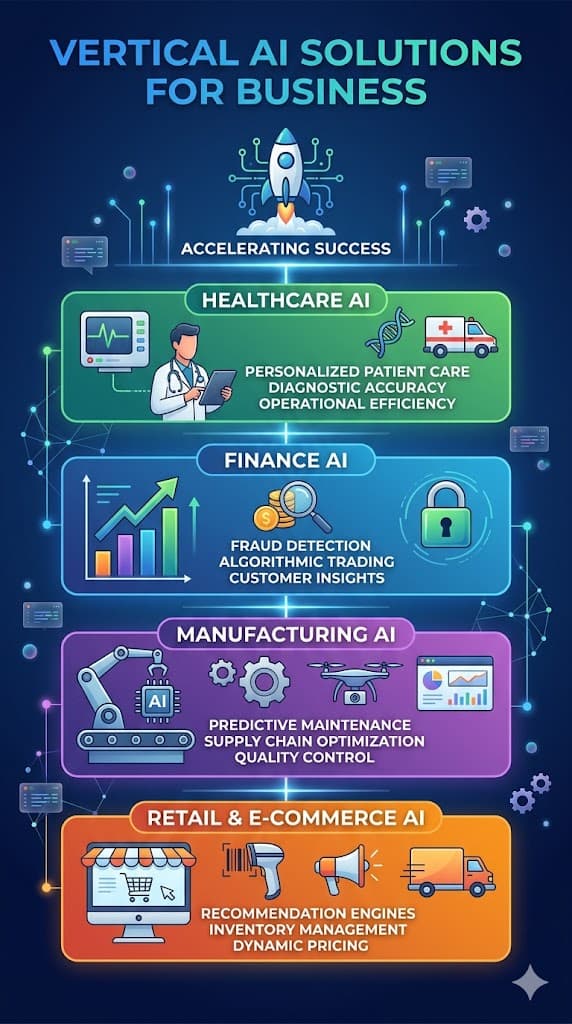
Business leaders face relentless pressure. Driving innovation is key to staying competitive. General-purpose AI offers broad capabilities. However, it often falls short of specific enterprise needs. Your organization needs precision and context.
The future of enterprise AI is specialized. We must look beyond broad applications. This playbook helps you navigate 2026. It focuses on implementing vertical AI solutions for business.
Vertical AI Solutions for Business: Your 2026 Strategic Playbook
The AI landscape is shifting dramatically. Industry-Specific AI & Domain Models for 2026 are rapidly gaining traction. These specialized systems offer enhanced precision. They deliver superior business outcomes. May 2026 reports highlight surging investor interest. New product launches confirm this trend. Enterprises increasingly prioritize context-aware AI.
This strategic guide provides clarity. It outlines a structured implementation path. We aim to address common implementation gaps. You will find insights on measurable ROI. We also cover practical challenges. This playbook helps evaluate platforms. It secures your competitive edge. It helps build robust vertical AI solutions for business.
Key Takeaways for Enterprise Leaders
- Vertical AI excels in specific domains.
- It provides measurable business impact.
- Strategic planning is crucial for adoption.
- Data quality is paramount for success.
- Leverage specialized platforms or partners.
Why Vertical AI is Your 2026 Imperative
The shift towards specialized AI is undeniable. General AI models are versatile. However, they lack deep domain understanding. Why Domain-Specific AI Outperforms General-Purpose Models is clear. These models deliver greater precision. They offer more relevant insights. This makes them ideal vertical AI solutions for business.
Beyond General Purpose: The Power of Specialization
Imagine AI that speaks your industry's language. This is the promise of domain-specific AI. These industry-specific AI models are trained differently. They use specialized datasets and rules. This ensures accuracy in complex environments. It helps meet compliance standards.
They understand unique terminology. They also comply with specific regulations. This level of understanding boosts performance. It delivers insights general AI cannot. Enterprises are seeing the difference. This drives widespread adoption. It secures a competitive advantage.
Tangible ROI: AI Specialization Business Benefits
The AI specialization business benefits are significant. Companies report enhanced efficiency. They achieve reduced operational costs. Fraud detection improves in finance. Predictive maintenance transforms manufacturing. The Flip AI voice agent reached substantial revenue. This showcases strong market demand. It validates specialized AI's impact.
Improved decision-making is another key advantage. Vertical AI provides highly relevant data. This empowers leaders to act decisively. It translates directly into competitive gains. Tangible business outcomes are the result. These benefits define successful vertical AI solutions for business.
Building Your Vertical AI Playbook: A Step-by-Step Guide
Implementing vertical AI solutions for business requires a structured approach. This guide outlines key phases. It helps ensure successful integration. Focus on clear objectives and measurable results. A well-defined playbook is essential for success.
-
Phase 1: Strategic Planning & Opportunity Identification
Begin by identifying specific operational pain points. Analyze areas ripe for significant improvement. Focus on processes where specialized AI adds most value. Define clear, measurable key performance indicators (KPIs). Assess your existing data infrastructure. Understand data readiness for AI initiatives. Prioritize projects with high ROI potential. A solid strategy underpins all effective vertical AI solutions for business. Engage stakeholders early in this phase.
-
Phase 2: Data Foundation & Custom AI Development
High-quality, domain-specific data is crucial. Invest in data collection and cleansing. Ensure robust data governance is in place. Consider options for custom AI development for industries. Partnering with experts can accelerate this. Oracron Digital offers advanced AI solutions. They can tailor models to your needs. This ensures alignment with industry regulations. Custom software development further supports unique needs. It helps build powerful vertical AI solutions for business.
-
Phase 3: Platform Selection & Integration
Evaluate available enterprise vertical AI platforms. Look for solutions designed for your industry. Consider scalability, security, and integration capabilities. Assess vendor expertise in your specific domain. Some platforms offer pre-trained AI copilots for specific tasks. This can expedite deployment. A robust API strategy is essential. Seamless integration with existing systems is key. This phase secures your technological backbone.
-
Phase 4: Deployment, Monitoring & Iteration
Deploy vertical AI solutions incrementally. Start with pilot programs for testing. Continuously monitor performance metrics. Gather feedback from end-users. Iterate and refine models based on insights. This agile approach ensures continuous improvement. It maximizes the long-term value. Effective monitoring optimizes your vertical AI solutions for business. AI-driven software development can streamline this process.
Overcoming Implementation Challenges
Adopting vertical AI is not without hurdles. Data quality and availability are common issues. Enterprises often face data silos. Ensuring data privacy and security is paramount. Complex legacy system integration also poses a challenge. Seek expert assistance for seamless transitions. Consider a phased rollout to mitigate risks.
Talent gaps can hinder progress. Skilled AI engineers and data scientists are in demand. Ethical considerations must also be addressed. Robust AI governance frameworks help mitigate risks. AI Governance and Compliance for Businesses is vital. Plan for these challenges proactively. Successfully addressing these ensures robust vertical AI solutions for business. Implementing RAG for Enterprise AI can also improve context.
The Future is Specialized: Vertical AI Investment Trends
The market is rapidly validating specialized AI. The rise of vertical AI agents is a clear indicator. Surging investor interest confirms this trajectory. Reports from March and May 2026 show rapid growth. Companies are prioritizing specialized AI. They seek solutions understanding industry nuances. This reflects strong vertical AI investment trends.
New product launches dominate headlines. The Flip AI voice agent case study is inspiring. Inside Flip: The Vertical AI Voice Agent achieved substantial revenue. This proves the value of specialization. It demonstrates strong market adoption. This success fuels further development of vertical AI solutions for business. Expect continued innovation in this space.
Consider the growth of AI copilots for specific tasks. These tools embed intelligence directly into workflows. They empower employees with targeted assistance. This enhances productivity across departments. Such specialized applications are driving the market. They represent a significant competitive advantage. Businesses must adapt their strategies. Embracing these innovations is crucial. Advanced AI agents unlock further potential.
Frequently Asked Questions About Vertical AI
What is the core difference between general-purpose AI and vertical AI?
General-purpose AI models train on broad datasets. They perform diverse tasks. However, they lack deep domain expertise. Vertical AI is domain-specific AI. It fine-tunes with specialized data. This includes regulations and terminology. It performs highly accurate tasks. These are within a specific industry. They also apply to an operational domain. This specialization drives greater precision. It provides more relevance. It leads to tangible business outcomes.
Which industries are seeing significant benefits from vertical AI solutions?
Financial services leverage vertical AI. This boosts fraud prevention. It automates compliance. Examples include KYC and AML. Manufacturing and supply chain sectors benefit too. They use predictive models. These optimize maintenance and inventory. Healthcare attracts significant investment. It accelerates drug discovery. It improves medical data analysis.
How can businesses effectively implement vertical AI?
Businesses must identify specific pain points. Or, find opportunities for clear ROI. Prioritize high-quality, domain-specific data. Establish robust governance. Consider existing vertical AI platforms. Or partner with expert digital agencies. This ensures solutions align with industry needs. It matches regulations and workflows.
Next Steps with Oracron Digital
Ready to unlock the power of specialized AI? Oracron Digital helps implement vertical AI solutions for business. We design and deploy custom platforms. Our team ensures alignment with your strategic goals. Contact us today to discuss your unique needs. Transform your operations with precision AI. Discover how Oracron can be your strategic partner.