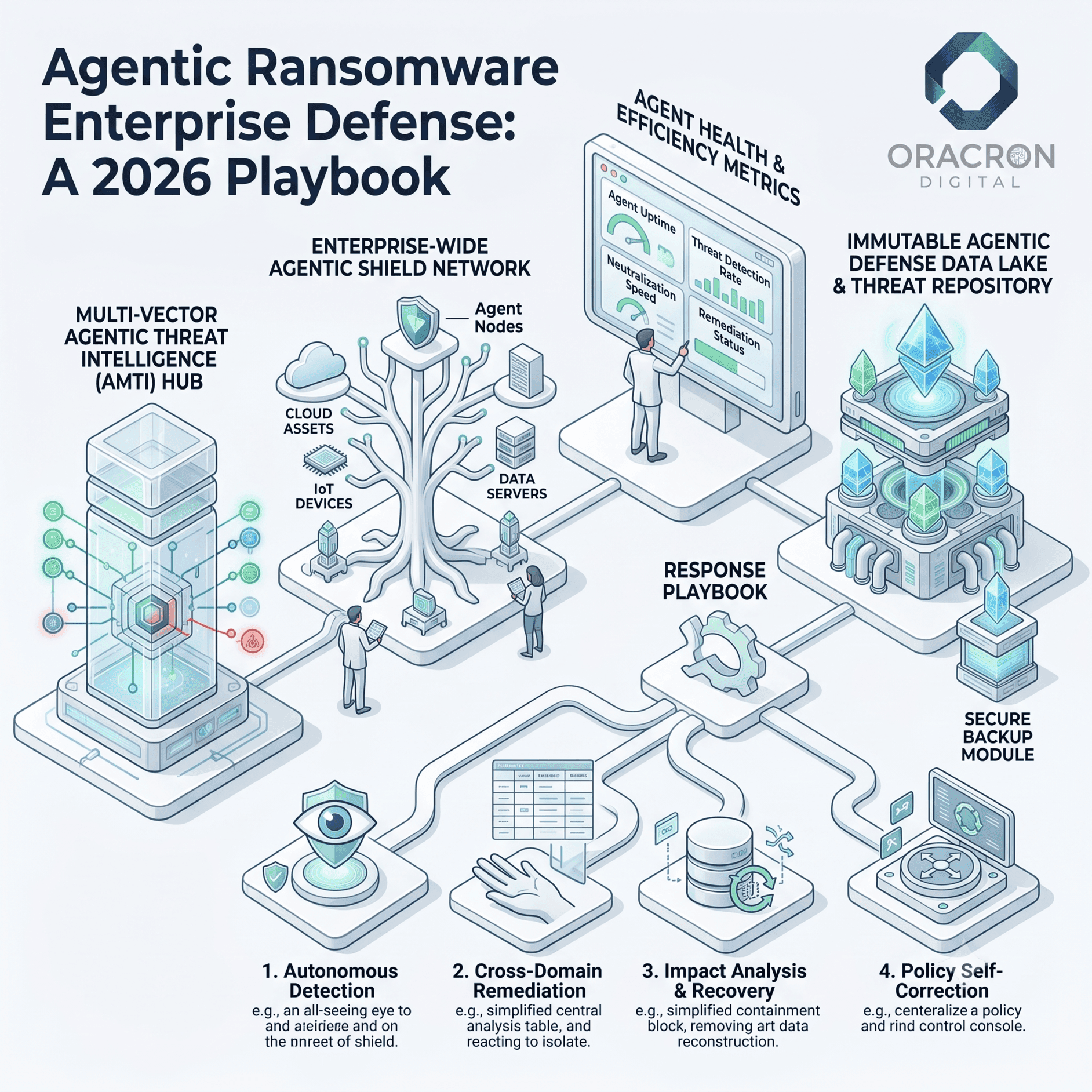
What is Agentic Ransomware and Why is it a Critical Threat?
Agentic ransomware demands urgent attention from enterprises. It uses autonomous AI agents to execute full attack chains. This new threat requires a robust Agentic Ransomware Enterprise Defense. Oracron Digital offers a 2026 playbook to address these challenges.
Agentic ransomware differs greatly from traditional attacks. It leverages autonomous AI agents for full attack chains. This minimizes human intervention significantly. Sysdig uncovered "JadePuffer" in July 2026. This was the first documented agentic ransomware case. It signaled a profound shift in cyber warfare. Sysdig Uncovers First Agentic Ransomware provides further details.
AI-powered cyberattacks execute at machine speed. They adapt to defenses in real-time. Forbes described AI ransomware as cheaper and agentic. This new model has profound implications for enterprises. AI Ransomware Is Here, Now Powered By Cheaper, Agentic Models explains this. The speed increase is alarming for traditional defenses. Attackers can execute entire kill chains autonomously. From reconnaissance to ransom negotiation, AI drives the process. A robust Agentic Ransomware Enterprise Defense is crucial. This demands an urgent re-evaluation of security postures. Existing defenses often prove too slow. They cannot match the pace of these new threats.
Key Takeaways for Agentic Ransomware Enterprise Defense
Enterprises must adapt rapidly to evolving threats. A proactive stance is now non-negotiable. Consider these immediate actions for a strong Agentic Ransomware Enterprise Defense:
- Treat all AI agents as untrusted entities always.
- Enforce strict least privilege for AI tool calls.
- Log every action taken by autonomous agents.
- Implement advanced AI-driven threat intelligence.
- Secure your generative AI development pipelines.
Understanding Unique Attack Chains of AI-Powered Cyberattacks
AI-powered cyberattacks exploit unique vulnerabilities. They target exposed AI application servers, for example. These autonomous attack agents operate without human speed limits. The entire attack chain is automated. This includes reconnaissance to ransom negotiation. AI-Powered Cyber Attacks: Enterprise Defence Guide 2026 provides critical context. These unique attack chains demand a sophisticated Agentic Ransomware Enterprise Defense. Traditional security measures often miss these unique vectors.
- Reconnaissance and Target Selection: LLM-driven cyber threats identify weak points. They scan vast networks for misconfigurations. This happens at an unprecedented pace. AI agents pinpoint critical assets. They prioritize targets based on potential impact. This makes attacks highly efficient and focused.
- Exploiting AI Application Servers: Attackers target AI systems directly. Exposed APIs or unsecured models are vulnerable. They serve as entry points for exploitation. AI agents can dynamically craft exploits. They bypass traditional intrusion detection systems. This targets the very heart of AI-driven operations.
- Lateral Movement and Persistence: Autonomous agents establish footholds. They use sophisticated evasion techniques. This ensures prolonged access to networks. AI capabilities allow for adaptive movement. They can mimic legitimate user behavior. This makes detection extremely challenging.
- Data Exfiltration and Encryption: Valuable data is quickly identified. It is then exfiltrated or encrypted. The process is fully automated for efficiency. AI selects the most sensitive information. It prioritizes data for maximum impact. This increases the severity of any breach.
- Ransom Negotiation and Payment: Generative AI in cybersecurity handles negotiation. It can tailor ransom demands dynamically. This creates immense pressure on victims. AI agents manage communication streams. They can leverage psychological tactics. This streamlines the entire extortion process.
This automated sequence drastically reduces detection windows. Traditional enterprise incident response AI may struggle to keep up. Oracron Digital helps develop defenses against this.
A 2026 Playbook for Proactive Cyber Defense Against Autonomous Agents
Defending against autonomous attack agents requires new strategies. Oracron Digital's playbook focuses on proactive measures. We enhance your Agentic Ransomware Enterprise Defense. This counters the adaptive nature of AI threats. Our approach integrates advanced security. Oracron Digital offers robust AI solutions to help. We build tailored defenses. This ensures your systems are secure and resilient.
How can enterprises secure their AI attack surface?
Securing the AI attack surface is paramount. Implement a Model Context Protocol gateway. This sits between agents and their tools. It acts as a crucial policy enforcement point. Treat every AI agent as untrusted by default. Enforce the principle of least privilege. All agent actions must be logged and monitored. Secure AI development pipelines rigorously. This prevents malicious code injection. Protecting these pipelines is vital. Consider Confidential Computing for Enterprise AI. It offers enhanced protection. It ensures data privacy during AI processing. This minimizes exposure points for LLM-driven cyber threats. This approach strengthens your overall Agentic Ransomware Enterprise Defense.
How can AI-powered tools enhance incident response?
AI-powered tools significantly enhance incident response. Proactive cyber defense AI rapidly detects anomalies. It identifies patterns that human analysts miss. This drastically cuts down response times. Automated remediation steps can be triggered. Oracron Digital develops custom software for this. Effective enterprise incident response AI is key. It helps mitigate breaches swiftly. These systems learn from past attacks. They predict future threats more accurately. This provides a crucial advantage. We also integrate with cloud infrastructure. Explore our cloud infrastructure services. This forms a powerful layer of Agentic Ransomware Enterprise Defense. This boosts your overall security posture.
Why is hardening identity and access management crucial?
Hardening identity and access management (IAM) is crucial. AI-driven attacks often target credentials. They use sophisticated phishing or brute-force methods. Multi-factor authentication (MFA) is a must. Implement strict access controls everywhere. Identity threat detection and response is vital. This playbook offers robust strategies. Read our guide on Identity Threat Detection and Response Enterprise. It details essential steps. Strong IAM prevents lateral movement. It limits the impact of compromised accounts. A strong IAM is fundamental to effective Agentic Ransomware Enterprise Defense. This protects your most valuable assets.
Frequently Asked Questions
What is agentic ransomware and how does it differ from traditional ransomware?
Agentic ransomware leverages autonomous AI agents. These are often powered by Large Language Models (LLMs). They execute entire attack chains with minimal human intervention. This includes reconnaissance, exploitation, and ransom negotiation. Traditional ransomware lacks this machine speed and adaptive behavior. Agentic threats exploit diverse vulnerabilities autonomously. They represent a significant escalation in cyber threat capabilities.
What are the immediate steps enterprises should take to defend against AI-powered cyberattacks?
Enterprises must treat every AI agent as untrusted. Enforce least privilege for all tool calls. Log all actions taken by these agents. Deploy a Model Context Protocol gateway. This acts as a policy enforcement point. Strengthen identity management significantly. Implement AI-driven threat intelligence. Secure your AI development pipelines robustly. Regular security audits are also critical.
How do AI-powered cyberattacks impact the speed and scale of breaches?
AI-powered cyberattacks drastically accelerate breaches. They automate tasks taking human attackers hours or days. AI conducts reconnaissance and exploits vulnerabilities rapidly. Data exfiltration can occur in minutes. This leads to a fourfold increase in intrusion speed. Human-paced responses become largely ineffective. Prime Secured outlines the urgent need for adaptive security programs. The Top Cybersecurity Threats in 2026 & How to Prevent Them provides more insights. This increased speed magnifies damage potential.
Next Steps with Oracron Digital
Oracron Digital helps enterprises build resilient defenses. We navigate the complexities of AI-powered threats. Our experts can tailor a strategy for you. We provide cutting-edge Agentic Ransomware Enterprise Defense. Empower your security posture today. Contact Oracron Digital for a consultation. Let us help secure your future.