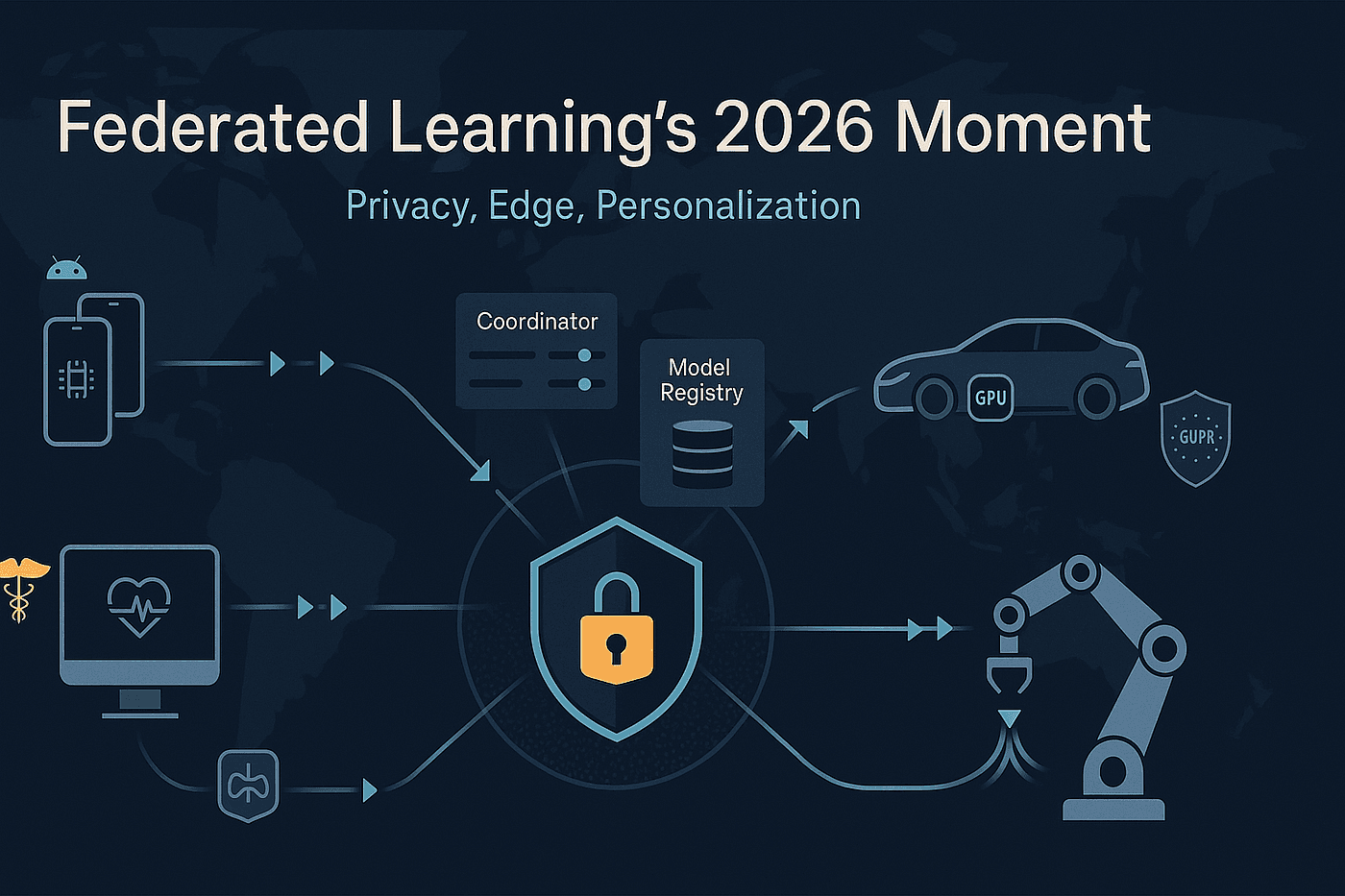
Federated Learning Enterprise Adoption: Your 2026 Playbook
Federated Learning enterprise adoption is crucial for privacy-centric AI. It enables distributed AI training on local data. This approach ensures regulatory compliance and secure multi-party computation. Organizations achieve collaborative intelligence without data sharing.
Key Takeaways for Enterprise Leaders
- Federated Learning is vital for privacy-preserving AI.
- It facilitates data silo collaboration securely.
- Scalable infrastructure is key for production success.
- MLOps integration is essential for ongoing operations.
- Compliance drives its growing market adoption.
Why is Federated Learning Enterprise Adoption Critical Now?
Federated Learning enterprise adoption is critical today. Rising data privacy demands drive its necessity. Strict regulations like GDPR and HIPAA require new approaches. The market expects significant growth through 2035.
Projections show a 30.50% CAGR from 2026. This market will reach USD 1,590.80 million. This architecture is vital for modern enterprise AI. It offers a clear competitive advantage. Federated Machine Learning Gives Enterprises a Competitive AI Advantage, an April 2026 report, highlights these benefits.
Major tech companies expand their FL portfolios. This lowers adoption barriers for businesses. Google, Microsoft, IBM, and NVIDIA lead this trend. Their efforts simplify complex deployments. Businesses gain competitive AI capabilities. Federated Learning Market Size, Share and Trends 2026 to 2035 confirms these trends.
How Does Federated Learning Enable Privacy-Preserving AI?
Federated Learning enables privacy-preserving machine learning by keeping data local. AI models are trained on decentralized datasets. Only aggregated model updates are shared. This process prevents raw data from leaving its source. It drastically reduces data exposure risks.
This architecture facilitates Confidential Computing for Enterprise AI. It supports secure multi-party computation effectively. Data remains within organizational boundaries. This is crucial for AI Solutions in sensitive sectors. Organizations can collaborate on AI models. They do so without compromising proprietary or personal data. This approach meets stringent regulatory compliance AI needs.
What are the Core Components of a Federated Learning System?
A Federated Learning system involves several key components. Local client devices or servers hold the data. A central server aggregates model updates. A secure communication protocol facilitates interaction. This setup enables distributed AI training. It supports on-device AI models.
- **Clients**: Local entities performing model training.
- **Aggregator**: Central server collecting updates.
- **Secure Aggregation**: Cryptographic techniques for privacy.
- **Communication Layer**: Ensures secure update transmission.
- **Model Orchestration**: Manages training rounds and deployment.
What Does an Enterprise Implementation Playbook Look Like?
Implementing Federated Learning enterprise adoption requires a structured approach. A clear roadmap guides technology leaders. This ensures successful scaling from prototype to production. Scaling Federated Learning: A Road Map for Technology Leaders provides strategic guidance. Oracron Digital helps organizations navigate this complex journey.
How Can Enterprises Overcome Technical Challenges?
Enterprises face several technical hurdles during implementation. Data heterogeneity (Non-IID data) is a common issue. This variation can affect model convergence. Oracron Digital uses advanced aggregation techniques to address this. Differential privacy can be applied for enhanced security.
Robust distributed infrastructure is essential. This infrastructure must support scalable operations. Cloud Infrastructure plays a vital role here. It provides the necessary computational resources. Secure aggregation protocols are also critical. Homomorphic encryption can protect model updates. Oracron Digital helps design these resilient systems.
Integrating Federated Learning with Existing Enterprise Systems
Seamless integration with existing data governance frameworks is vital. Federated Learning must align with current cybersecurity protocols. This ensures a holistic security posture. Oracron Digital helps integrate new AI systems. We ensure compliance with corporate policies. This includes robust access controls.
AI/ML operations (MLOps) are crucial for lifecycle management. MLOps ensures continuous integration and deployment. It supports monitoring and retraining of models. This is key for production-grade Federated Learning. Oracron Digital provides AI-Native Platform Engineering expertise. This streamlines model development and deployment.
What are Key Steps for Successful Federated Learning Enterprise Adoption?
Successful Federated Learning enterprise adoption follows a methodical path. This roadmap outlines essential actions for technology leaders. These steps ensure a robust and compliant deployment. Oracron Digital guides clients through each phase.
- **Assess Privacy & Compliance Needs**: Identify specific data regulations. Determine sensitive data points and their governance.
- **Pilot Project & Proof of Concept**: Start with a well-defined, smaller scope. Validate the technical feasibility and privacy guarantees.
- **Infrastructure Design**: Plan for distributed AI training capabilities. Select scalable custom software and hardware.
- **Security & Governance Integration**: Embed Federated Learning into existing security protocols. Ensure robust auditing and access controls.
- **MLOps & Lifecycle Management**: Establish practices for model versioning and monitoring. Plan for ongoing model updates and maintenance.
- **Scalability Planning**: Design for future expansion and increased data sources. Optimize for efficient resource utilization.
The Federated AI Market Outlook 2026-2034 highlights these drivers. Data privacy regulations are a significant force. Edge computing also contributes to growth. Federated AI Market Outlook 2026-2034 confirms its expanding role.
Which Industries Benefit Most from Federated Learning?
Industries with stringent data privacy regulations benefit greatly. These sectors often have siloed, sensitive data. Federated Learning is crucial for data silo collaboration. It allows powerful AI insights without compromising privacy.
- **Healthcare**: Collaborative diagnostics and drug discovery. Patient data remains protected on-device.
- **Finance**: Fraud detection and risk assessment across institutions. No direct sharing of customer transaction data.
- **Manufacturing**: Predictive maintenance with data from multiple factories. Each plant retains its operational data.
- **Automotive**: Autonomous driving model training from diverse vehicles. Vehicle data stays decentralized.
Frequently Asked Questions
How does Federated Learning ensure data privacy in enterprise AI?
Federated Learning ensures data privacy by enabling AI models to be trained locally on decentralized datasets without directly sharing raw data. Only aggregated model updates or parameters are sent to a central server, significantly reducing the risk of data exposure and facilitating compliance with regulations like GDPR and HIPAA.
What are the main challenges of implementing Federated Learning in an enterprise?
Key challenges for enterprise implementation include managing data heterogeneity across diverse sources, establishing robust distributed infrastructure, ensuring secure aggregation of model updates, and overcoming the technical complexity of system setup and ongoing AI/ML operations for production-grade deployments.
Which industries are primarily adopting Federated Learning today?
Industries with stringent data privacy regulations and siloed, sensitive data are leading Federated Learning adoption. This includes healthcare (for collaborative diagnostics), finance (for fraud detection and risk assessment), manufacturing (for predictive maintenance), and the automotive sector (for autonomous driving).
Next Steps with Oracron Digital
Oracron Digital offers expert guidance for your Federated Learning journey. We help design, implement, and scale privacy-preserving AI. Our team ensures your solutions meet compliance needs. Contact Oracron Digital today to discuss your enterprise AI strategy. Explore our AI services for more information.